What You Are Actually Eating
What the dishes on a Québec food tour are, where they come from, and why nobody — including the historian who wrote the book — knows how pâté chinois got its name.
Most of these turn up on a food tour in Old Québec. Two of them have origin stories that are genuinely unresolved, and that is more interesting than a tidy answer would be.
Poutine
Fries, fresh cheese curds, hot brown gravy. The curds must squeak; that is not romance, it is the freshness test.
It emerged in Centre-du-Québec in the late 1950s, and who invented it is contested between at least three claimants:
Warwick, 1957. Fernand Lachance at the Café Idéal, asked by a regular to put curds in a bag of fries, reportedly said “ça va faire une maudite poutine” — that’ll make a damned mess. Gravy is generally said to have been added around 1962, to keep it warm. This is the most-repeated account, and the Lachances long maintained that real poutine was fries and curds only, no gravy at all.
Drummondville, at Le Roy Jucep, where Jean-Paul Roy was the first to serve all three components together as one menu item — originally fromage-patate-sauce. The restaurant holds a registered trademark asserting it invented poutine, and the Canadian intellectual-property office issued a certificate to that effect. Sources disagree on the year, giving 1958 or 1964.
Princeville, at La Petite Vache, where customers mixed curds into their fries often enough that it went on the menu as Mixte.
Nobody has settled it, and each town is quite firm about it.
Pâté chinois
Ground beef, then creamed corn, then mashed potato. Cousin to shepherd’s pie and to hachis Parmentier, and the comfort food of a Québec childhood.
Nobody knows why it is called Chinese pie, and this is not us hedging.
The best research — by food historian Jean-Pierre Lemasson and linguist Gabriel Martin — places its origin with the French-Canadian working class in Montréal in the 1910s, spreading widely during the 1930s Depression. On the name, the field has two theories and one discredited one:
The railway-worker story — that Chinese labourers on the transcontinental railway were fed cheap beef, potato and corn — is rejected. Lemasson notes those workers ate mainly rice and soy, and the dish did not become common until the 1930s, decades later.
The China, Maine theory, advanced by linguist Claude Poirier, holds it is a calque of “China pie”, brought back by French Canadians who went to Maine for industrial work. It is carried in the historical dictionary of Québec French and presented as fact by at least one dictionary. Martin rejects it as resting on second-hand testimony, and no trace of the dish was found in Maine.
Lemasson’s book on the subject is titled Le mystère insondable du pâté chinois — the unfathomable mystery — and he has said on the record that if he found the real origin he would win a Nobel Prize. What he will say firmly is that it is a dish created in Québec and eaten in Québec.
Ask your guide. Everyone has a theory and none of them can prove it.
Sucre à la crème
Soft maple fudge, and one of very few recipes genuinely invented in Québec.
Québec’s language authority gives it a formal definition: a fondant confection traditionally made from maple sugar or maple syrup and cream, cooked to the soft-ball stage between 117 and 119°C, then worked as it cools. Modern versions commonly use white sugar with cassonade — brown sugar — and butter.
Denser and grainier than fudge, and considerably sweeter than you expect.
Cretons
A cold pork spread, eaten on toast at breakfast, seasoned with onion and warm spices — cinnamon, clove, allspice, savory.
The language authority is precise and worth repeating, because nearly every English-language source gets it wrong: cretons resemble French rillettes in principle but are not rillettes. They are a minced-pork forcemeat pâté.
The name is probably Norman, from cretouns — the shrivelled residue left from rendering fat. Made with veal or poultry instead of pork it is properly cretonnade, and it is not the same thing as tête fromagée, head cheese.
Tourtière
A meat pie — minced pork, veal or beef with potato, sometimes game — and the centrepiece of the réveillon, the Christmas Eve and New Year’s Eve meal.
There is no single correct filling. Coastal regions use fish, including salmon; inland it is pork, beef, rabbit or game.
Mind the regional trap. Tourtière du Lac-Saint-Jean is a different dish — much deeper, made with cubed meat and potato rather than minced, cooked for hours, and iconic to the Saguenay since the Second World War. Ordering one expecting the other is a common and entirely forgivable mistake.
Maple taffy — tire sur la neige
Maple syrup boiled to the soft-ball stage and poured in ribbons over clean packed snow, then rolled onto a wooden stick as it sets into chewy taffy. The doneness test is the snow itself: when the poured syrup sits on the surface instead of sinking, it is ready.
It is a March-to-April thing. This is the temps des sucres, eaten at cabanes à sucre during a partie de sucre. Some food tours serve a version year-round, which is a fair approximation and not the same event.
Worth knowing: tapping maples is an Indigenous practice that long predates European arrival in North America. The sugar shack is a later wrapper around a much older technology.
Île-aux-Grues cheddar
Turns up by name on one of the tours here, and it earns the billing.
It is a thermised-milk cheddar made exclusively from milk produced on Île-aux-Grues itself, an island in the St Lawrence downstream of Québec City. The cows are fed partly on hay grown on the island’s shoreline, unfertilised and unsprayed, nourished by the salt water of the river — which is what the producer credits for the flavour.
The producer is a farmers’ cooperative, founded in 1976 by the island’s fourteen dairy farmers so they could process their own milk, and it is now described as the largest artisanal cheesemaker in Canada.
And it is precarious in a way worth knowing while you eat it. Of those fourteen farms, three remain. The island is down to around a hundred year-round residents from 850 in the 1800s, and roughly half the working population works at the cheese dairy. The cheese leaves by boat in summer and by aeroplane in winter.
Eat them in the right order
Tours That Cover the Range
A good guide gets you the full arc in one afternoon rather than four separate meals.
Book the Walking Tour, Budget for the Rest
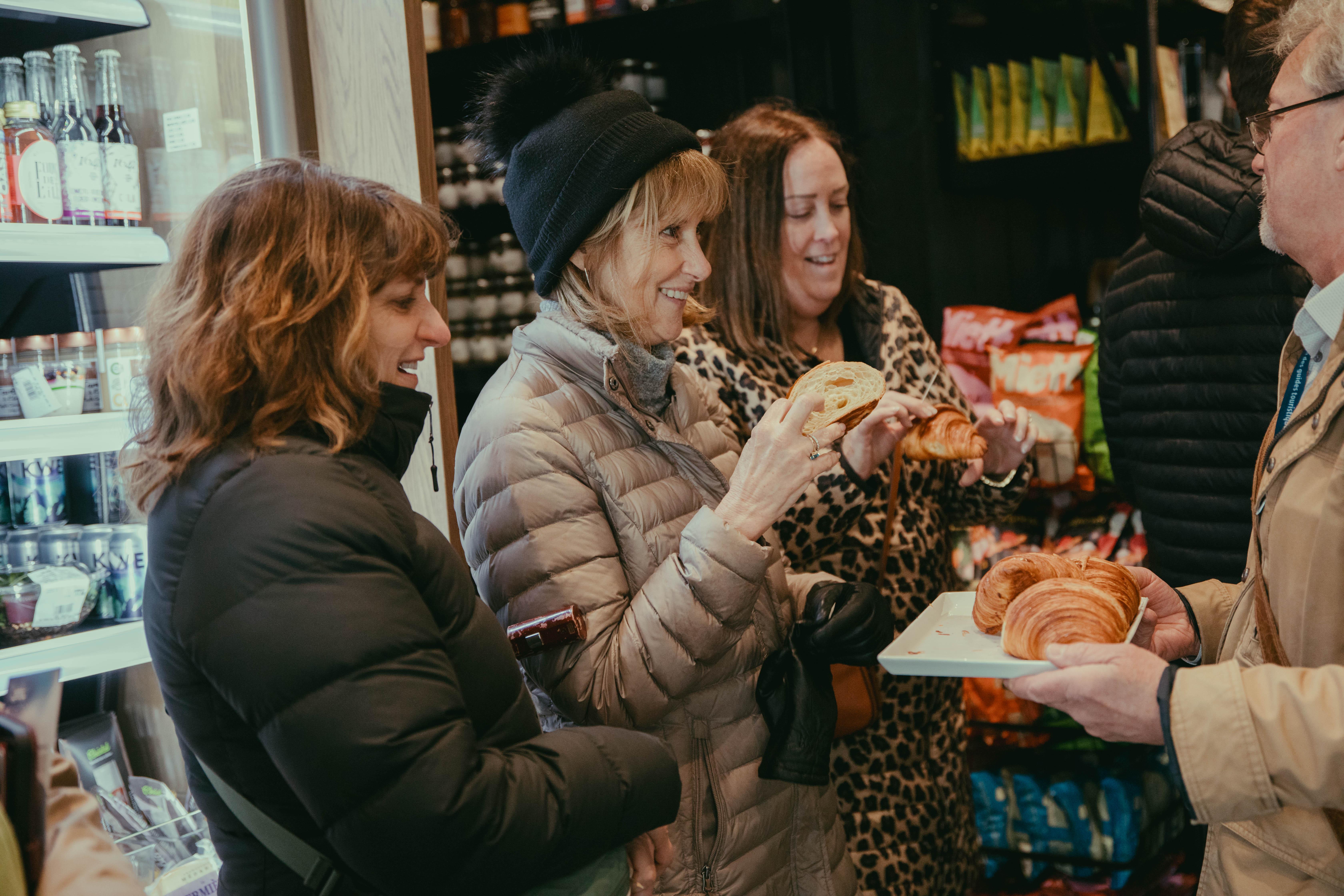
The most-booked food tour in Old Québec runs ten or more tastings through the historic district with a local guide — 4.8/5 from 275 verified guests, from about $125. Gratuities are excluded and a tip is customary. Free cancellation.
Check Availability & Book